

A sixty-dollar will kit might seem like a smart way to save money, but in the wrong situation it can become a sixty-thousand-dollar problem for your family in probate fees, legal disputes, and missed planning opportunities. This article delivers a true cost comparison, looking past the upfront price tag to reveal the real financial implications of each estate planning option.
The Upfront Price Tag: What Each Option Actually Costs
Understanding the initial financial outlay for creating your last will and testament is crucial, but it is only the first step in assessing the true cost of securing your estate. This section breaks down the immediate expenses associated with both DIY wills and hiring an estate planning attorney.
DIY Will Costs Across Online Services, Software, and Free Templates
The appeal of a low-cost or even free will is strong. Numerous online services, software programs, and readily available templates offer a do-it-yourself approach to estate planning, typically ranging from zero to two hundred and fifty dollars. LegalZoom offers a Basic Will starting at ninety-nine dollars and a Premium Will at two hundred forty-nine dollars. Trust and Will charges one hundred ninety-nine dollars for individuals and two hundred ninety-nine dollars for couples, including a will, power of attorney, and healthcare directive. Rocket Lawyer offers single document purchases at thirty-nine ninety-nine or unlimited document access through its thirty-nine ninety-nine monthly subscription. Free templates from Quicken WillMaker, FreeWill, and similar services bring the floor down to zero. While these options present genuine upfront cost savings, that minimal investment does not necessarily cover the full spectrum of most people’s needs.
Estate Planning Attorney Costs: Flat Fees Versus Hourly Billing
Engaging an estate planning attorney typically involves a higher initial cost. A simple standalone will runs three hundred to one thousand two hundred dollars. A flat-fee comprehensive package including a will, financial power of attorney, healthcare directive, and living will typically costs one thousand five hundred to three thousand five hundred dollars. Complex estates involving trusts, business succession, blended families, or significant tax exposure run five thousand to ten thousand dollars or more. Hourly rates range from two hundred to five hundred dollars in most US markets, with major metropolitan areas pushing higher. This investment reflects personalized legal expertise and a comprehensive plan that a qualified professional provides, ensuring your wishes are precisely documented and legally sound. When you hire an attorney, you are not just paying for a document but for specialized knowledge and experience.
Why the Price Gap Is Misleading
The significant price gap between DIY wills and attorney services can be misleading. The initial savings on a DIY option often fail to account for potential hidden costs and complications that may arise later, especially during probate. It is crucial to look beyond the immediate dollar difference and consider the long-term financial implications and the peace of mind that a professionally drafted estate plan can offer your family. Many people overlook the true cost by focusing solely on the upfront expenditure.
What You Actually Get with a DIY Will
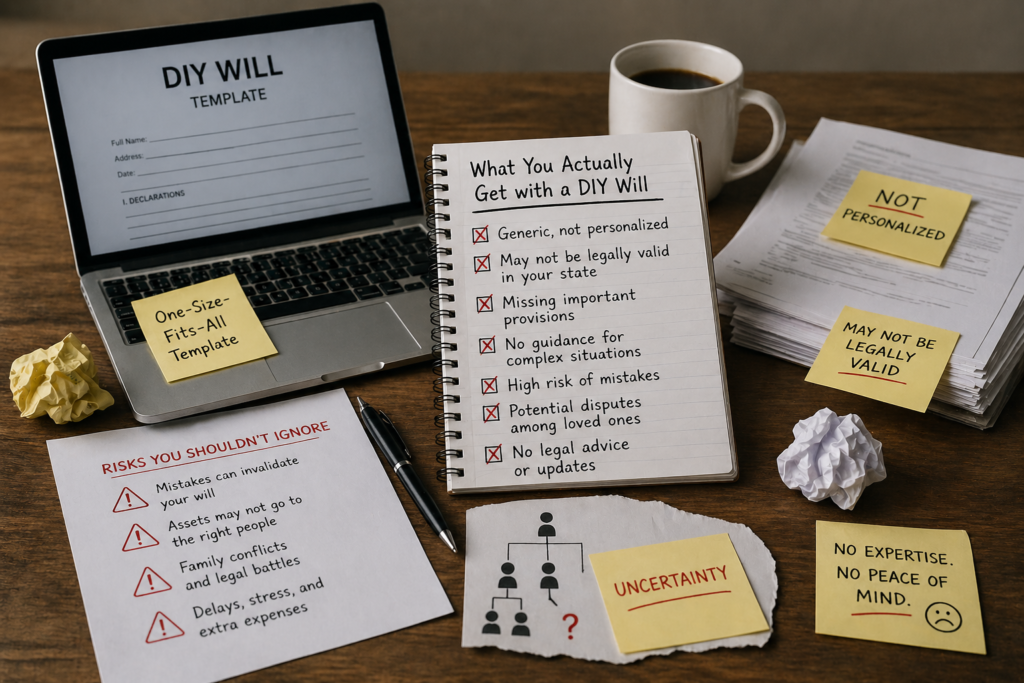
Exploring the offerings of DIY will platforms reveals a convenient and accessible way to draft basic estate documents, but it is essential to understand the scope and limitations of what these services provide for your personal circumstances.
What Is Included in Popular DIY Platforms
Popular DIY will platforms like LegalZoom, Trust and Will, and Rocket Lawyer typically include templates for a basic last will and testament, powers of attorney, and healthcare directives, allowing users to input their personal information and designate beneficiaries. These services aim to make estate planning accessible for people with straightforward wishes, often guiding users through a series of questions to populate the necessary legal documents. While seemingly comprehensive, the content is generally generalized and not personalized to complex individual needs.
What Is Missing and Why It Matters
What is often missing from DIY wills, and why it matters significantly, is the personalized legal advice and strategic planning that an estate planning attorney provides. These platforms cannot account for complex family dynamics, special needs beneficiaries, or intricate asset structures, potentially resulting in a document that does not truly reflect your intentions or stand up to legal scrutiny. This oversight can create considerable distress and financial burdens for your loved ones, ultimately costing more than the initial savings.
What an Estate Planning Attorney Brings to the Table
Hiring an estate planning attorney offers far more than just drafting documents. It provides a comprehensive and personalized approach to securing your legacy and protecting your loved ones.
Personalized Legal Strategy Beyond a Fill-in-the-Blank Form
An estate planning attorney brings a personalized legal strategy that extends far beyond filling in the blanks of a generic form, meticulously tailoring your will and estate plan to your unique financial situation, family structure, and personal wishes. They assess all your assets, liabilities, and potential future scenarios to craft a plan that anticipates challenges and minimizes potential disputes, ensuring your intentions are clearly and legally articulated.
Tax Planning, Trust Structures, and Beneficiary Protection
Estate planning attorneys are skilled at intricate tax planning, helping to minimize estate taxes and maximize the inheritance for your beneficiaries through strategies like establishing various trust structures. They also prioritize beneficiary protection, ensuring that assets are distributed according to your specific wishes, especially for minor children, special needs beneficiaries, or those with unique circumstances. This expertise is particularly valuable in states with low estate tax exemptions, where proper planning can save your family hundreds of thousands of dollars.
Witnessing, Notarization, and Proper Execution
A critical service an estate planning attorney provides is ensuring proper execution of your will and other essential documents, overseeing the witnessing and notarization processes to meet all state-specific legal requirements. Most US states require two witnesses, some allow self-proving affidavits with notarization, and a handful recognize holographic wills (handwritten and signed by the testator). This attention to detail is vital in preventing future challenges to the will’s validity and avoiding costly probate court complications. Improper execution is one of the most common reasons DIY wills fail.
Ongoing Relationship for Life Changes
An estate planning attorney typically fosters an ongoing professional relationship, offering continuous support and modifications to your estate plan as you experience significant life changes such as marriage, divorce, having children, or acquiring new property or business interests. This ensures your plan remains current, reflecting your evolving circumstances and preventing outdated documents from causing unintended consequences in the future.
The Hidden Costs of DIY Wills: The True Cost Section
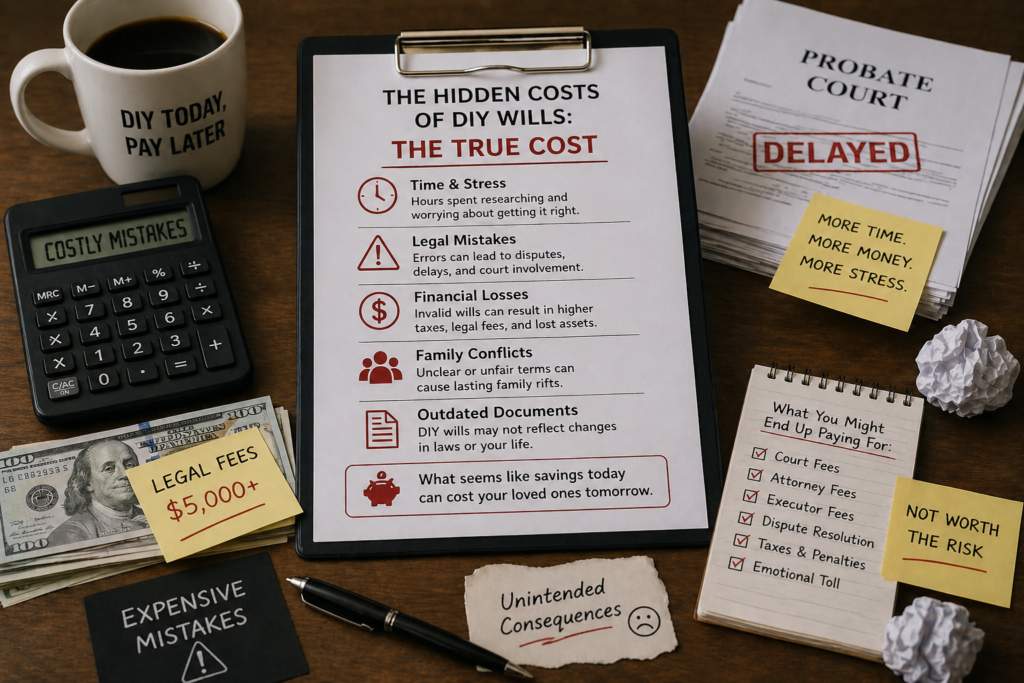
While a DIY might appear to save money initially, the true cost often emerges later, manifesting in significant financial burdens and emotional distress for your family during an already difficult time.
Probate Court Complications and Delays
One of the highest hidden costs of a DIY will is the potential for extensive probate court complications and delays, which can tie up your assets for months or years. According to the American Bar Association, probate takes an average of sixteen months and costs three to eight percent of estate value. On a five-hundred-thousand-dollar estate, that translates to fifteen thousand to forty thousand dollars in court costs, attorney fees, and executor compensation before your family receives anything. Without proper legal guidance, a DIY will often lack the precision and compliance required, leading to challenges and prolonged proceedings that could have been avoided with a professionally drafted plan.
Invalid Wills Due to Improper Execution
A common hidden cost of DIY wills stems from the potential for them to be declared invalid due to improper execution, a frequent mistake when individuals attempt to draft their own documents without legal oversight. Issues such as lacking the required number of witnesses, incorrect notarization, or failure to adhere to specific state laws can render the will null and void, meaning your assets may not be distributed according to your wishes. This can result in your estate being treated as if no will existed, with distributions determined by state intestacy laws.
Family Disputes and Contested Wills
DIY wills carry a higher risk of disputes when language is ambiguous or provisions are missing. Most wills, DIY or attorney-drafted, are not contested, but when challenges do happen, the cost is high. A study of four hundred forty-three probate cases in San Francisco found that contested wills incurred an average of seventeen thousand dollars in additional attorney fees. When a will is not clear or does not account for all potential scenarios, it can ignite legal battles that erode family relationships and significantly increase legal costs, a true cost far greater than the initial savings.
Missed Tax Saving Opportunities
Another substantial hidden cost associated with DIY wills is the missed tax-saving opportunities that a knowledgeable estate planning attorney would identify. While the federal estate tax affects very few estates today, state-level estate and inheritance taxes hit many more families. Without professional guidance, individuals may overlook strategies such as credit shelter trusts, irrevocable life insurance trusts, charitable giving structures, or coordinated gifting plans that could significantly reduce state estate tax exposure. These missed opportunities can result in a considerable portion of your estate being diminished by taxes.
Outdated or Jurisdiction Mismatched Templates
Using outdated or jurisdiction-mismatched templates is a critical hidden cost of DIY wills. Estate planning laws vary significantly by state and change over time, which can render a generic document ineffective or invalid. An online template might not reflect the current legal landscape of your specific state, leading to legal challenges, incorrect asset distribution, or the need for costly court intervention to correct errors.
Real World Example: The Aretha Franklin Handwritten Will Dispute
The Aretha Franklin case starkly illustrates the hidden costs and complications that can arise from informal estate planning, even for those with extensive assets. After her death in 2018, multiple handwritten documents were discovered in her home, including a four-page will found wedged between couch cushions. These were holographic wills, handwritten and signed by Franklin without the formal witnessing typical of professionally drafted wills. About half of the US states recognize holographic wills, and Michigan is one of them. After years of family disputes and legal battles among her sons, a Michigan probate court jury ruled in July 2023 that the 2014 handwritten document was valid. The will was upheld, but the family had spent five years in court fighting over which version of her wishes should govern an estate valued at roughly eighteen million dollars. This case shows that even when a DIY-style will is technically valid, ambiguity and informality can cost a family years of conflict and substantial legal fees.
When a DIY Will Might Actually Be Enough
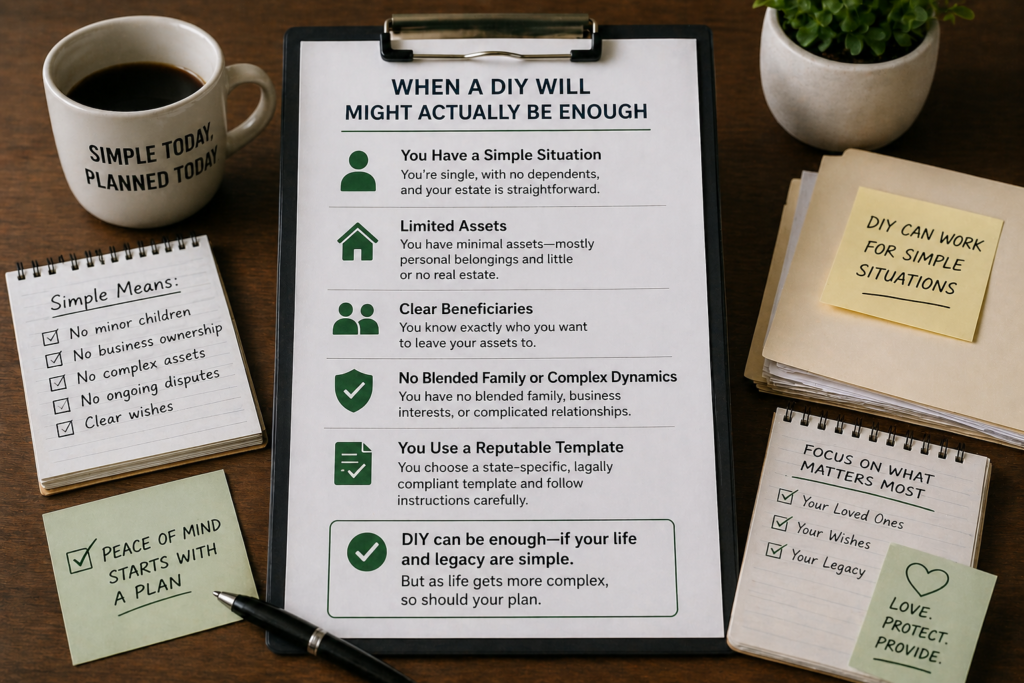
Being honest about when a DIY will can suffice builds trust and offers a balanced perspective.
Single Individuals with No Children and Minimal Assets
For single individuals with no children and minimal assets, a DIY will might be enough to cover basic estate planning needs, particularly if asset distribution wishes are straightforward. When there are few beneficiaries and a low overall estate value, the complexities that typically necessitate an attorney are absent.
No Business Ownership or Property Across Multiple Jurisdictions
Individuals without business ownership or property across multiple states often find a DIY will sufficient, as their estate plan does not need to account for complex legal frameworks or varied state laws.
Straightforward Beneficiary Wishes
When someone has straightforward beneficiary wishes, a DIY will can effectively document their intentions for asset distribution. If there are no complex provisions for special needs beneficiaries, charitable giving, or specific trusts, an online will template might adequately cover these uncomplicated requests.
Using a DIY Will as a Temporary Stopgap
A DIY will can serve as a temporary stopgap, providing legal coverage for your estate until you can develop a more comprehensive plan with an attorney. While not ideal as a long-term solution, it offers immediate peace of mind for people facing urgent circumstances such as upcoming travel, surgery, or military deployment.
When You Absolutely Need an Estate Planning Attorney
Certain life situations and asset complexities demand professional legal expertise.
Blended Families or Minor Children
When dealing with blended families or minor children, you need an estate planning attorney to draft a comprehensive plan that addresses the unique complexities involved. An attorney can establish trusts for minor children, navigate the legal intricacies of blended family dynamics, and ensure clear guardianship provisions, preventing future disputes.
Business Ownership or Partnership Interests
For those with business ownership or partnership interests, hiring an attorney is essential to ensure a smooth transition. An attorney can draft specific provisions or establish appropriate trusts to manage your business interests, prevent costly disputes, and ensure continuity.
Real Estate Across Multiple Jurisdictions
If you own real estate across multiple states, an attorney is indispensable to properly manage these assets. Each state has unique property and probate laws, and without proper planning, your estate may face ancillary probate in every state where you own property, multiplying both costs and delays.
Estate Values Above Tax Exemption Thresholds
For most American families, the federal estate tax is no longer a concern. As of January 1, 2026, the federal estate and gift tax exemption is fifteen million dollars per individual and thirty million dollars for married couples through portability, under the One Big Beautiful Bill Act signed into law in July 2025. Anything above that is taxed at a flat forty percent. In practical terms, this means fewer than one in a thousand estates will owe federal estate tax in 2026.
The bigger issue for most people is state-level estate and inheritance taxes, where the thresholds are dramatically lower and the planning often more urgent. Twelve states and the District of Columbia impose their own estate tax. Massachusetts has one of the lowest exemptions at two million dollars and is not indexed for inflation, meaning more estates fall into it every year. Oregon sits at one million dollars. New York’s exclusion is seven million three hundred fifty thousand dollars in 2026, but New York uses a cliff rule where estates exceeding one hundred five percent of the threshold owe tax on the entire estate value, not just the amount above the exclusion. Six additional states impose an inheritance tax, where the heir pays based on what they receive and how closely related they are to the deceased. These include Iowa, Kentucky, Maryland, Nebraska, New Jersey, and Pennsylvania.
If your estate is anywhere near these state thresholds, or if you own property in multiple states with different tax rules, an estate planning attorney becomes essential. They can structure trusts, lifetime gifting, and asset titling to legally reduce your taxable estate. A DIY will gives you no tools to address state estate tax exposure, and the cost of getting it wrong can run into the hundreds of thousands of dollars on a moderately sized estate.
For Canadian readers, the framework is different. Canada has no federal estate tax or inheritance tax. Instead, the Canada Revenue Agency treats death as a deemed disposition, meaning capital gains tax may be owed on appreciated assets transferred at death. Provincial probate fees, sometimes called estate administration tax, also apply and vary widely by province. Ontario charges roughly one and a half percent of estate value above fifty thousand dollars, while Alberta caps probate fees at five hundred and twenty-five dollars regardless of estate size.
Special Needs Beneficiaries
For individuals with special needs beneficiaries, it is imperative to hire an attorney to create a specialized trust, such as a special needs trust, ensuring their financial security without jeopardizing their eligibility for government benefits like Supplemental Security Income or Medicaid. A DIY will can easily make a mistake here, leading to significant financial hardship for your loved one, whereas a personalized attorney plan offers crucial protection.
Charitable Giving Plans
If you have specific charitable giving plans, an attorney can help structure these donations effectively through your will or trust, maximizing their impact and potential tax benefits. Proper structuring can also reduce your taxable estate in states with an estate tax.
Anyone Who Wants Trusts Rather Than Just a Will
Anyone who wants to establish trusts needs an attorney, as trusts offer enhanced control over asset distribution, probate avoidance, and greater privacy than a will alone. An attorney can draft the appropriate trust structures, whether a revocable living trust, irrevocable trust, special needs trust, or charitable trust, to meet specific goals that a DIY will cannot cover.
DIY Will vs Attorney: Side-by-Side Comparison
Choosing between a DIY will and an estate planning attorney requires looking past the upfront price to the full picture.
Comparison of Upfront Cost, Time Investment, and Customization
A DIY will costs anywhere from zero dollars for a free template to about two hundred and fifty dollars for a premium online service like LegalZoom Premium or Trust and Will. Most people complete the questionnaire and download their documents within an hour or two. The trade-off is that you are working from a template designed to cover the broadest possible audience, with limited room for customization beyond standard fields like beneficiaries, executors, and guardians for minor children.
An estate planning attorney typically charges three hundred to one thousand two hundred dollars for a simple standalone will, one thousand five hundred to three thousand five hundred dollars for a flat-fee comprehensive package, and five thousand to ten thousand dollars or more for complex estates. Hourly rates range from two hundred to five hundred dollars in most US markets. The process usually takes two to six weeks from initial consultation to signed documents, but every clause is tailored to your actual circumstances.
Legal Review, Tax Planning, and Probate Avoidance
This is where the two paths diverge most sharply. A DIY platform produces a document. An estate planning attorney produces a strategy.
Legal review on most DIY platforms is either nonexistent or available only as an upsell. LegalZoom offers attorney review of completed documents for an additional forty-nine to one hundred forty-nine dollars, and Rocket Lawyer bundles thirty minutes of attorney consultation per month into its thirty-nine ninety-nine subscription. Neither is the same as having an attorney draft your plan from scratch with full knowledge of your finances and family situation.
Tax planning is essentially absent from DIY platforms. They cannot structure a credit shelter trust to use both spouses’ state estate tax exemptions, set up an irrevocable life insurance trust to remove a policy from your taxable estate, or coordinate gifting strategies across multiple years. For estates near or above state estate tax thresholds, this is the single biggest financial gap between the two options.
Probate avoidance is where attorneys deliver the most measurable long-term value. A revocable living trust drafted and properly funded by an attorney can keep most of your estate out of probate entirely, saving your heirs three to eight percent of estate value in court costs, executor fees, and attorney fees. A DIY will, no matter how well drafted, still has to go through probate.
Total Lifetime Cost Considerations
The honest comparison is not what you spend today, it is what your estate spends over the next twenty or thirty years. A DIY will at fifty dollars looks cheaper than a two thousand five hundred dollar attorney package on the day you sign it. But probate on a five-hundred-thousand-dollar estate typically costs fifteen thousand to forty thousand dollars, and a contested will adds an average of seventeen thousand dollars in additional legal fees. State estate tax on a Massachusetts estate just above the two-million-dollar threshold can run into six figures without proper planning. Run those numbers, and the DIY savings of a few hundred dollars become a rounding error against the potential downstream costs.
The Real Math: A 20 Year Cost Comparison
Hypothetical Estate Analysis
Consider a married couple in their fifties with a combined estate of seven hundred fifty thousand dollars, including a paid-off home valued at four hundred fifty thousand dollars, retirement accounts of two hundred fifty thousand dollars, and fifty thousand in other assets. They have two adult children and live in a state with a two-million-dollar estate tax exemption, so they do not expect any estate tax exposure.
The DIY path costs them about one hundred fifty dollars for two online wills with healthcare directives and powers of attorney. The attorney path costs them three thousand dollars for a complete plan, including a revocable living trust, pour-over wills, powers of attorney, and healthcare directives, with the trust properly funded with their home and non-retirement assets.
The upfront difference is two thousand eight hundred fifty dollars in favor of DIY.
Probate Fees, Taxes, and Legal Disputes Over 20 Years
Twenty years later, both spouses have passed. Under the DIY scenario, the estate has grown to roughly one million one hundred thousand dollars due to home appreciation and investment growth. Because the estate passes through probate, the family pays approximately five percent in combined probate costs, court fees, and executor fees, totaling fifty-five thousand dollars. The will’s wording about dividing the home between the two adult children was ambiguous, leading to a six-month dispute and an additional eighteen thousand dollars in legal fees. Probate took fourteen months, during which the children could not access estate funds.
Under the attorney scenario, the funded living trust transfers ninety percent of the estate outside of probate. Total settlement costs run around eight thousand dollars, mostly for trustee work, final tax filings, and minor legal review. The transfer completes in roughly four months.
The difference: the DIY plan saved two thousand eight hundred fifty dollars upfront and cost the family approximately sixty-five thousand dollars more at settlement. The attorney plan delivered a net savings of about sixty-two thousand dollars to the heirs, plus ten months of faster access to inherited assets.
This is the true cost of saving money on a will. The savings are real but small, and the downstream costs are large and concentrated at the worst possible time for the family.
How to Choose the Right Path for Your Situation
Questions to Ask Yourself Before Deciding
Before deciding, ask yourself about the complexity of your estate, the number of beneficiaries, whether you have a blended family situation, or if you own property across multiple states. Consider whether you have minor children, special needs beneficiaries, or business interests. Check your state’s estate tax exemption and compare it to your net worth. These factors indicate a stronger need for an attorney to personalize your plan and address state-specific issues that a DIY platform cannot handle.
Questions to Ask an Estate Planning Attorney During a Consultation
During a consultation, ask the attorney about their experience with similar estate situations, their fee structure, and whether they offer flat fees or hourly billing for your type of plan. Ask how they handle ongoing updates as your circumstances or assets change, what tax planning strategies they recommend for your state, how they ensure proper execution of documents, and what happens if you need to update your plan in five or ten years.
Red Flags in DIY Platforms to Watch For
When considering DIY online will platforms, watch for the lack of state-specific guidance, generic templates that do not address your jurisdiction’s witnessing requirements, the absence of clear instructions on proper execution and notarization, and aggressive upselling of subscriptions that auto-renew. Be wary of platforms that promise to cover complex estate needs without offering direct attorney access, as this can lead to invalid wills or future family disputes.
Frequently Asked Questions
Is a DIY Will Legally Binding?
A DIY will can be legally binding if it meets all the specific legal requirements of your state, including proper execution, the required number of witnesses, and sometimes notarization. No US jurisdiction requires a will to be typewritten or professionally drafted by an attorney. The risk is not legal status but execution errors and ambiguity, which are common DIY mistakes that can invalidate the document or trigger probate disputes.
What Happens if a DIY Will Is Contested?
If a DIY will is contested, your family will likely face high legal costs and a prolonged probate court battle, as the lack of professional oversight often leaves ambiguities or legal vulnerabilities that make it easier to dispute. Contested wills add an average of seventeen thousand dollars in legal fees to the estate, on top of normal probate costs. The chances of disputes increase substantially when a will lacks clear, attorney-drafted language.
How Much Does an Estate Planning Attorney Cost on Average?
The cost of an estate planning attorney ranges from three hundred to one thousand two hundred dollars for a simple standalone will, one thousand five hundred to three thousand five hundred dollars for a flat-fee comprehensive package including a will, powers of attorney, and healthcare directives, and five thousand to ten thousand dollars or more for complex estates involving trusts, business succession, or significant tax planning. Hourly rates run from two hundred to five hundred dollars in most US markets.
Can I Write My Own Will and Have It Notarized?
You can write your own will and have it notarized, but notarization alone does not guarantee its legal validity. Most states require specific witnessing procedures, typically two adult witnesses who are not beneficiaries, in addition to or instead of notarization. Some states recognize holographic wills (entirely handwritten and signed by the testator), but many do not. Follow all your state’s laws for proper execution to prevent your DIY will from being contested or declared invalid.
Do Online Wills Hold Up in Court?
Online wills hold up in court when properly drafted and executed according to state law. They produce legally valid documents in all fifty US states. The risk is not whether they are valid but whether they are clear, complete, and aligned with your jurisdiction. The risk of probate problems and family disputes is higher with a generic DIY will than with a plan personalized by an estate planning attorney.
Conclusion and Call to Action
Reinforcing the True Cost Framing
While a DIY will might offer immediate dollar savings, the potential for probate fees, legal disputes, missed state tax planning opportunities, and family conflict often outweighs those initial savings. The genuine cost is not the upfront price; it is the long-term security and clarity that a personalized estate plan from an attorney provides for your family.
Call to Action
To ensure your estate plan truly serves your wishes and protects your family, take the next step. Book a consultation with an experienced estate planning attorney, download our comprehensive checklist for evaluating your needs, or use our tool to compare qualified attorneys in your area. Do not let a small upfront saving lead to a large future cost.

