

A small estate affidavit in Connecticut can allow certain qualifying estates to use a simplified probate procedure instead of full estate administration.
Settling an estate after someone dies does not always require a full probate administration. Connecticut provides a simplified procedure for certain smaller estates, allowing an eligible person to use an affidavit instead of going through the ordinary process of admitting a will to probate or obtaining letters of administration.
This procedure is commonly referred to as an Affidavit in Lieu of Probate of Will/Administration and uses Connecticut Probate Court Form PC-212.
The small estate process can reduce some of the time and paperwork associated with a full estate administration, but it is available only when specific requirements are satisfied. The value and type of property the decedent owned, how that property was titled, whether Connecticut real estate was owned individually, and the estate’s debts and expenses can all affect eligibility.
Understanding those requirements before filing can help families determine whether the small estate procedure is appropriate or whether a full probate estate will be necessary.
What Is a Small Estate Affidavit in Connecticut?
A Connecticut small estate affidavit is a simplified method for settling certain estates without formally opening a full probate administration.
Under Connecticut General Statutes § 45a-273, the procedure may generally be available when the value of the decedent’s qualifying solely owned personal property does not exceed $40,000 and the decedent did not own solely owned real property in Connecticut at the time of death. Property that passes outside probate by operation of law is excluded when applying the statutory personal-property limit.
Instead of seeking appointment of an executor or administrator through the ordinary process, an eligible person submits an affidavit to the Probate Court for the district where the decedent lived.
The procedure is still supervised by the Probate Court. It should not be understood as simply collecting a deceased person’s property without court involvement.
The court can use the process to determine how estate assets should be applied toward appropriate claims, expenses, and taxes and how any remaining property should be distributed.
Families dealing with an estate that does not qualify for this simplified procedure may instead need to proceed through the ordinary probate process.
What Is the $40,000 Small Estate Limit?
The central financial requirement is that the aggregate value of the decedent’s solely owned tangible and intangible personal property, excluding property that passes outside probate by operation of law, must not exceed $40,000.
This distinction is important because the $40,000 figure is not necessarily the same as the total value of everything connected to the person who died.
For example, some property may pass directly to another person because of the way the asset is owned or because a valid beneficiary arrangement applies. Those assets may not be part of the solely owned probate property used for the statutory calculation.
By contrast, personal property owned solely by the decedent that does not pass outside probate may count toward the limit.

What Types of Assets May Be Part of a Small Estate?
The small estate procedure focuses primarily on personal property rather than solely owned Connecticut real estate.
Depending on the circumstances, qualifying probate property can include items such as:
- Solely owned bank accounts
- Stocks or bonds held individually
- Unpaid wages owed to the decedent
- Motor vehicles owned in the decedent’s name
- Personal belongings and other tangible property
- Certain insurance proceeds when no beneficiary is entitled to receive them
- Other qualifying intangible personal property
The key is not simply what type of asset exists, but how the decedent owned it and how it passes at death.
A bank account owned solely by the decedent, for example, can be treated differently from an account that passes directly to a surviving owner by operation of law. Similar ownership and beneficiary questions can arise with investment accounts and other financial assets.
For that reason, families should identify each asset and determine how it is titled before deciding that an estate is below the $40,000 limit.
What If the Decedent Owned Real Estate?
Real estate can change the analysis significantly.
Connecticut’s small estate statute requires that the decedent have had no solely owned real property in Connecticut at death. A house, condominium, land, or other Connecticut real property titled solely in the decedent’s name can therefore prevent use of the ordinary small estate procedure under § 45a-273.
Ownership should be verified rather than assumed. Real property held with another owner under a survivorship arrangement may present a different situation from property owned solely by the decedent.
This is one reason the apparent dollar value of an estate alone is not enough to determine eligibility.
Who Can File the Small Estate Affidavit?
Connecticut law establishes an order of people who may file the affidavit.
The decedent’s surviving spouse may file first. If there is no surviving spouse, the decedent’s next of kin may file. If there is no next of kin, or if the surviving spouse and next of kin refuse to file, the Probate Court may allow another person with a sufficient interest in the estate to do so. The statute specifically recognizes that this can include a person or entity owed a qualifying claim, expense, or tax.
The affidavit is filed in the Probate Court for the district where the decedent resided.
What Form Is Used for a Connecticut Small Estate?
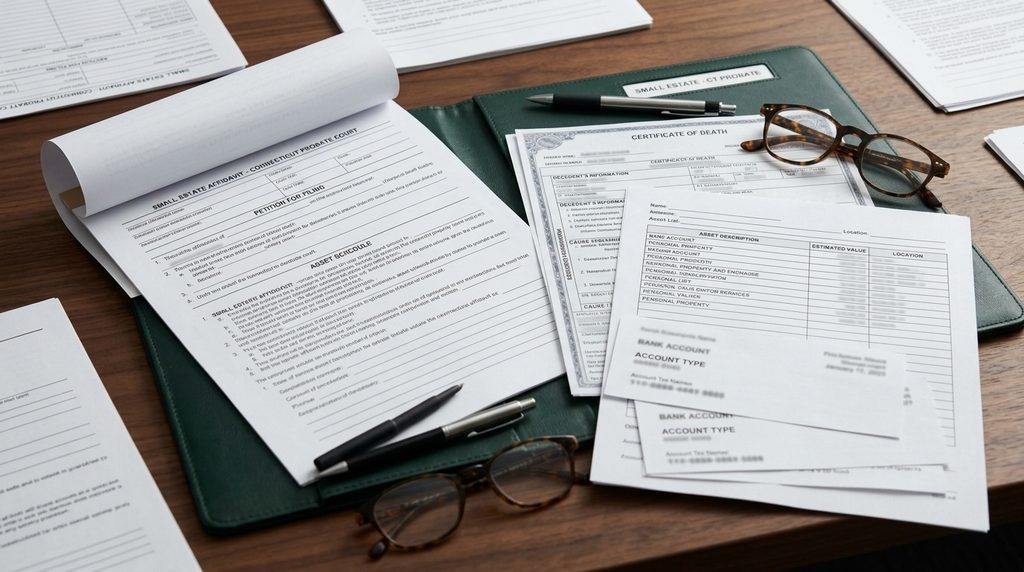
The primary form is PC-212, Affidavit in Lieu of Probate of Will/Administration.
The official instructions state that PC-212 is intended for the small estate procedure under § 45a-273 and identify the $40,000 personal-property limit and real-estate restriction. The form also requires information about the decedent’s assets, claims, expenses, taxes, and certain state assistance.
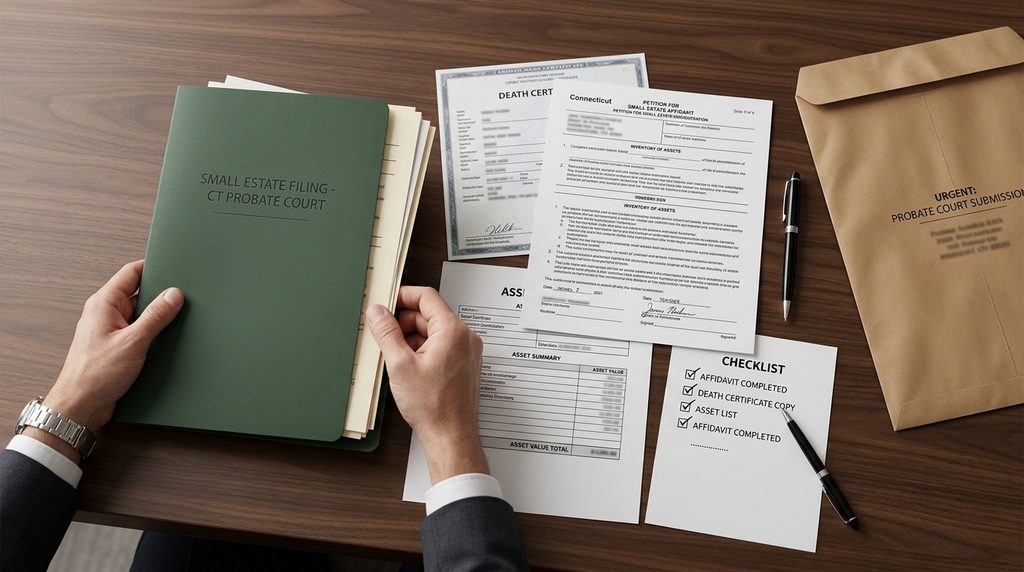
A copy of the death certificate with the Social Security number redacted must generally accompany the filing, along with the separate confidential-information form containing the decedent’s Social Security number. Depending on whether assets remain after claims and expenses, an additional request for an order of distribution may also be required.
How Do You Complete the Small Estate Affidavit Process?
The person filing PC-212 must provide accurate information about the decedent’s property and the obligations that may need to be paid from the estate.
This generally means identifying the decedent’s solely owned probate assets, their values, and the claims, expenses, and taxes associated with the estate. The form also asks whether any listed expenses or claims have already been paid and, if so, who paid them.
Accuracy matters because the affidavit is signed under penalty of false statement. Families should avoid estimating asset values or leaving out accounts simply to bring an estate below the $40,000 limit.
Once the affidavit is submitted, the Probate Court reviews the information and determines whether the estate qualifies for the simplified procedure.
Is There a Waiting Period After PC-212 Is Filed?
Connecticut law includes an important 30-day requirement.
Under Connecticut General Statutes § 45a-273, Connecticut law includes an important 30-day requirement.After receiving the affidavit, the Probate Court sends a copy to the Connecticut Department of Administrative Services. The court may not issue its decree until 30 days after the affidavit was sent to the department.
This period gives the state an opportunity to address certain claims that may affect the estate. It should not be confused with a rule that every small estate is automatically completed exactly 30 days after filing.
The actual timing can depend on whether the filing is complete, whether additional information is needed, and whether questions arise about assets, claims, beneficiaries, or the decedent’s will.
How Are Debts and Funeral Expenses Handled?
The small estate procedure does not allow heirs or beneficiaries to receive property ahead of valid estate obligations simply because the estate is small.
PC-212 requires information about claims, funeral expenses, administration expenses, taxes, and other qualifying obligations.
The Probate Court can authorize estate assets to be used to pay people or organizations entitled to payment. If someone used personal or nonprobate funds to pay a qualifying estate expense, the procedure may also allow reimbursement in appropriate circumstances.
When there is not enough estate property to pay every obligation in full, Connecticut law establishes priorities for payment. Families should therefore be careful about distributing property informally before understanding the estate’s debts.
What Happens If Money Is Left After the Debts Are Paid?
If estate assets exceed the claims, expenses, and taxes that must be addressed, the remaining property may be distributed to the appropriate heirs or beneficiaries.
A Request for Order of Distribution, Form PC-212A, may be required when assets remain for distribution.
Who receives the remaining property can depend on whether the decedent left a will and what that will provides.
If there is no will, the remaining property is generally distributed according to Connecticut intestacy law. If there is a valid will that provides for a different distribution, additional requirements can apply before the small estate procedure can be used to carry out those wishes.
What Happens If the Person Left a Will?
The existence of a will does not automatically prevent use of the small estate process.
However, the distribution instructions in the will matter.
If the will provides for the same distribution that would occur under Connecticut intestacy law, the process can be relatively straightforward. If the will directs a different distribution, Connecticut law may require heirs to waive their right to contest the will before the Probate Court orders distribution according to its terms.
If the necessary consent or waiver cannot be obtained, formal probate of the will may become necessary.
This is an important distinction because a small estate affidavit is not always a substitute for probate when family members disagree about who should receive the estate.
When Is Full Probate Administration Necessary?
A simplified small estate procedure may not be appropriate when:
- Qualifying solely owned personal property exceeds $40,000
- The decedent owned solely owned Connecticut real estate
- The validity or terms of a will are disputed
- Ownership of important assets is unclear
- Family members disagree about distribution
- More extensive court authority is needed to resolve estate issues
In those situations, ordinary estate administration may provide the legal authority and court supervision needed to collect assets, address claims, and complete distributions properly.
[Internal Link 2: Link “estate administration” to Legacy Law Partners’ Estate Administration service page]
Small estates can also become more complicated if additional property is discovered after the affidavit has been filed. Families should contact the Probate Court or seek legal advice if newly discovered assets could affect the estate’s eligibility.

Frequently Asked Questions
Can You Avoid Probate in Connecticut If the Estate Is Under $40,000?
Certain qualifying estates may use the simplified affidavit procedure instead of formal probate administration. The $40,000 limit is only one requirement. The decedent also generally cannot have owned solely owned Connecticut real estate.
Does a Car Count Toward the Connecticut Small Estate Limit?
A solely owned motor vehicle may be part of the personal property considered in a small estate. However, ownership and any beneficiary designation should be reviewed before determining whether a particular vehicle is included.
Do You Still Need PC-212 If There Is a Will?
A qualifying estate may potentially use PC-212 even when the decedent left a will. The terms of the will and whether they differ from intestate distribution can affect what additional consents or proceedings are required.
What If the Estate Is Worth More Than $40,000?
If the qualifying solely owned personal property exceeds the statutory limit, the estate generally will not qualify for the small estate procedure under § 45a-273 and formal probate administration may be required.
Get Help With a Small Estate in Connecticut
The Connecticut small estate affidavit can make administration simpler for families when an estate meets the statutory requirements. However, determining what counts toward the $40,000 limit, how assets are titled, which obligations must be paid, and how the remaining property should be distributed is not always straightforward.
Legacy Law Partners can help families evaluate whether an estate qualifies for the small estate procedure and determine what steps may be necessary to transfer property and complete the administration properly. Contact Legacy Law Partners to schedule a consultation.
The 30-day requirement and distribution rules above come directly from Connecticut’s current small-estate statute, §45a-273. The Connecticut Probate Courts also confirm that PC-212A may be required when assets remain after expenses and debts have been addressed.

